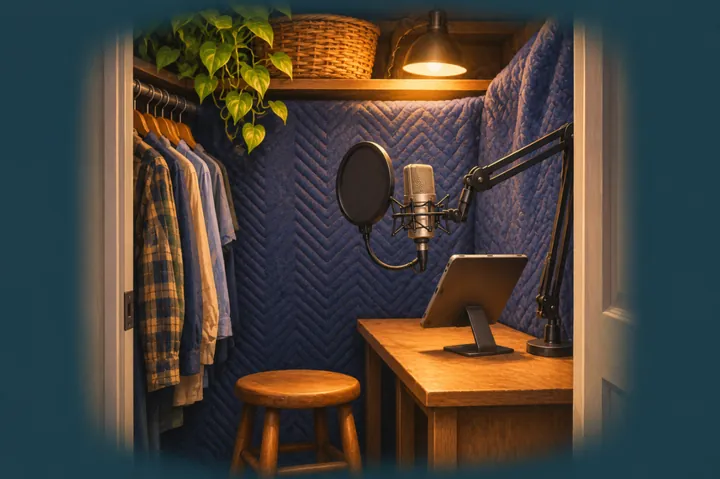
What you are trying to achieve
Two different problems get lumped together as "bad sound":
- Noise is sound from somewhere else: traffic, a refrigerator, a computer fan, the neighbor's dog. ACX requires a noise floor no higher than -60 dB RMS, so background noise is a pass or fail issue.
- Echo (room reflections) is your own voice bouncing off hard walls. It makes a recording sound hollow and far away. It will not fail a meter, but listeners and reviewers hear it at once.
Soft material fixes echo. It does very little for noise. Blankets will not stop a lawnmower. For noise you choose a better spot, a better time of day, or you switch the noisy thing off.
Pick the space
Go for the smallest, softest, most central space in your home.
- A walk-in or reach-in clothes closet. Hanging clothes are excellent absorbers, the space is small, and closets are usually away from outside walls.
- A corner of a carpeted bedroom, facing into heavy curtains or a blanket hung behind the microphone, with another behind you.
- A blanket booth. A frame of PVC pipe or two clothes racks with moving blankets over the sides, back and top.
Avoid kitchens, bathrooms, rooms with bare floors, and any room that shares a wall with a street, a laundry machine or a TV.
Test the space before you buy anything
You can check a space with only a phone, and check it properly once you have a microphone.
- Stand in the space, clap once and listen. A sharp ringing tail means hard reflections. A dull thud is what you want.
- Record 30 seconds of silence at the time of day you plan to work. Listen back on headphones with the volume up. Name every sound you hear.
- Once your microphone is set up, record 30 seconds of silence at your normal recording level and drop the file into the ACX audio check. On a raw test like this, aim for a noise floor of -70 dB or lower. Mastering will raise it, and the finished file has to stay under -60 dB.
Repeat the test at different times. Many homes are quiet enough at 6 a.m. or after 9 p.m. and hopeless at 4 p.m.
Cheap treatment that works
- Moving blankets are the best value in audio. Hang them on the walls beside and behind you and, if you can, overhead. See moving blankets on Amazon
- Duvets, pillows and winter coats work as well as anything you can buy. Fill the closet.
- Something soft under your script. A hard desk reflects sound straight back into the microphone. Put a folded towel on it.
- A rug if the floor is bare.
Thin foam tiles look professional and do very little at speech frequencies. Skip them at first.
The usual noise sources and their fixes
| Noise | Fix |
|---|---|
| Computer fan | Put the computer outside the closet and run cables under the door, or record to a quiet laptop or tablet |
| Refrigerator, air conditioning, heating | Switch off while recording (put your car keys in the fridge so you remember to switch it back on) |
| Hum or buzz in the recording | Move cables away from power bricks, try another outlet, switch off dimmers and fluorescent lights |
| Traffic and neighbors | Record at quieter hours and add mass between you and the street: a closed door, a bookcase, a wardrobe |
| Chair squeaks and clothing rustle | Stand, or use a solid chair. Wear soft cotton, no jewelry |
| Page turns and mouse clicks | Read from a tablet and scroll with a silent tap |
For stubborn problems read fixing a noisy recording.
Set up the position
- Microphone about a hand's width (15 to 20 cm) from your mouth, pop filter between you and it.
- Aim the microphone slightly off to one side of your mouth so bursts of air from "p" and "b" sounds pass beside it.
- Screen at eye level so you do not tip your head down.
- Mark the floor or the stand with tape so you return to the same spot every session. A consistent sound across a whole book is one of ACX's requirements.
- Keep water within reach.
What you do not need yet
A commercial isolation booth, acoustic panels in every room, or a second microphone. Get your noise floor and your editing routine right in a closet first. Upgrade when paid work justifies it.
Next: gear by budget.